Reference document

The technical dossier,
without the brochure.

Architecture, requirements, network flows, limits. This document is addressed to the person who writes the specification, not to the one who signs it. The values it contains come from installations in service; those that depend on the configuration are flagged as such, and the constraints are written down.

  • Windows and Linux, standard hardware
  • Works with the network cut off
  • Perpetual offline licence
8source types that can be displayed
24zones per wall, up to 10 walls per workstation
4 + 4outputs and inputs per card
0flows to the Internet while running

The principle

A standard PC in place of the proprietary controller.

A conventional installation rests on a hardware video wall controller: a dedicated appliance, with its expansion cards, its software and its life cycle. When it reaches end of support, the whole chain has to be replaced, screens included.

Easy Multi Display moves that function into the software. The appliance becomes a PC running Windows, the expansion cards become off-the-shelf capture cards, and the screens already in place carry on serving. That is what makes it possible to refurbish a room without changing a single panel, and that is what keeps the hardware interchangeable over the years.

  • No proprietary hardware imposed
  • Existing screens are kept
  • Hardware is replaced part by part

THE SOFTWARE IS THE CONTROLLER

standard hardware · screens kept · no appliance to write off

Architecture

The chain, from the operator workstation to the screen.

Eight steps, in this order. Steps 2 to 4 disappear when the sources are already network addresses rather than workstations to mirror: that is the difference between the two architecture models described further down.

The sources

Business operator workstations, a digital TV receiver, IP cameras, web feeds, mapping. A source is either a physical video signal to capture, or a network address to display.

Duplication

The signal from an operator workstation is duplicated by an HDMI splitter (1 input, 2 to 4 outputs) placed at the workstation, or taken from a spare video output on its graphics card. The workstation carries on working normally: nothing is taken away from it, the picture is copied.

Transport

An HDMI cable when the distance allows it, otherwise a transmitter/receiver pair that carries HDMI over a CAT5e or CAT6 network cable, up to 40 metres. Here the network cable is only a physical carrier: no video travels on the IT network.

Capture

The signals arrive on one or two 4-input HDMI capture cards installed in the display server. A 4K multiviewer placed upstream aggregates four sources onto a single input when the number of workstations exceeds the capacity of the cards.

The display server

A PC running Windows or Linux executes Easy Multi Display. It is what composes the wall: splitting into zones, placing the sources, storing the scenarios. It replaces the proprietary hardware controller of a conventional installation.

The outputs

Each graphics card provides four video outputs. A second graphics processor brings the total to eight, and the integrated graphics circuit of the processor adds one more output. Remote screens are reached by the same HDMI over network cable transmitters.

The displays

A single large-format panel, a wall made of several televisions, a decision screen, a crisis screen, an outdoor screen. The software drives a single screen or a set of screens treated as one surface without distinction.

The control return path

Touchscreen, control tablet, remote keyboard and mouse, button panel. These are the only two-way links in the chain, carried over USB, and they too can be extended over network cable.

Two models

Mirroring workstations, or driving workstations.

Capture-based architecture

The sources are physical operator workstations. Their video signal is duplicated, carried, then captured. The video wall is connected to no IT network at all: the only link between a business workstation and the wall is a video cable. This is the model chosen in operations centres, and it is what allows workstations belonging to networks that must not talk to each other to sit side by side on the same wall.

Network-based architecture

The sources are internal addresses: dashboards, web applications, supervision systems. No capture card is needed. A master workstation drives display machines fitted with the EMD player over the local network, and those machines stay self-sufficient for display. This is the model chosen in industrial control rooms and in multi-site display.

The network cable does not carry IP video. In the capture-based architecture, the RJ45 acts as a physical carrier for HDMI and USB transmitter/receiver pairs. The signal stays HDMI from end to end: it crosses no switch, uses no VLAN and is visible to no machine on the network.

Platforms

Windows, Linux x64, Linux ARM.

The same software, the same features, on all three platforms. The service picks its operating system according to its own policy, not according to its video wall.

Windows 10 and 11, 64-bit

The original platform. A digitally signed installable version, and a portable version that runs from a folder with no administrator rights.

Linux x64

Ubuntu 20.04 or later and its derivatives, including public-sector distributions. No operating system licence to buy, and an estate that stays under the service’s control.

Linux ARM

A Raspberry Pi 5 is enough to drive a display point: a few watts, no fan, and a hardware cost with no common measure with a PC. Useful to multiply secondary screens without multiplying servers.

Why this matters in public procurement. A control room that has to move away from Windows - by policy, by licensing cost or by sovereignty requirement - does not have to change its display software or retrain its operators. The migration happens machine by machine, without questioning the tool. The Linux versions are delivered, installed and configured as part of the deployment: the freely downloadable trial covers the Windows version.

Requirements

The reference configuration.

This is the configuration we supply and the one we maintain. It is identical from one installation to the next: what varies from site to site is not the processing power, it is the number of video inputs and outputs.

Display server - reference configuration
ItemReferenceNote
Operating systemWindows 10 / 11 64-bit, or Linux on x64 and ARMThe same features on all three platforms. On Linux, Ubuntu 20.04 or later; on ARM, down to a Raspberry Pi 5
MotherboardFour PCI Express slotsA structuring constraint: it has to house 1 to 2 graphics cards and 1 to 2 capture cards
ProcessorIntel Core i9A model with integrated graphics frees up one extra video output
Memory32 GB64 GB on installations where two rooms are driven by the same machine
Storage1 TB SSD512 GB is enough for a machine with no local archiving
Graphics cardNVIDIA RTX 5060, four outputsTwo cards to go beyond four screens
Capture cardElgato Cam Link Pro, 4 HDMI inputsTwo cards for eight inputs. Datapath, Magewell, Blackmagic and AVerMedia are also recognised
Power supply850 WSized for two graphics cards
Sizing rule
RequirementOutputsCaptureNote
Up to 3 screens1 graphics card1 card, 4 inputsThe most common configuration in an emergency call centre (CTA)
4 to 5 screens1 graphics card + the integrated output of the processor1 to 2 cardsThe fifth output is taken from the graphics circuit of the processor
6 to 8 screens2 graphics cards1 to 2 cardsCommand room configuration, two walls or a wall plus side screens
More than 8 sourcesnot applicable2 cards + a 4K multiviewer upstreamA multiviewer aggregates four workstations onto a single capture input

One constraint to know before costing the project. Adapters that convert a DisplayPort output into HDMI are limited to 4K at 30 frames per second. This has no consequence for mapping, supervision or dashboards, which make up the bulk of an operational wall. For smooth 4K video, the native HDMI outputs of the graphics card have to be used instead.

Cabling

Duplication, transport, power.

HDMI splitter

One input, two to four outputs. Placed at the operator workstation, it copies the picture without disturbing the workstation. Alternative: use a spare video output on the graphics card of the workstation, when one is left.

HDMI over network cable transmitter

A transmitter and receiver pair, over CAT5e or CAT6, up to 40 metres. More robust and less bulky than a long HDMI cable. An equivalent model exists for USB, to extend the keyboard, the mouse and the touchscreen.

4K multiviewer

Placed upstream, it composes four sources into a single 4K picture and therefore takes up only one capture input. That is what makes it possible to go beyond eight mirrored workstations without multiplying the cards.

Power

Allow two 220 V sockets per workstation to be duplicated, and plan the display server as the hub of the cabling: ten to fifteen network cable runs leave it towards the screens, the control stations and the multiviewers.

Control stations

Wall-mounted touchscreen, control tablet sitting on the desk, programmable button panel, remote keyboard and mouse. All of them connect over USB and can be extended over network cable, just like the video.

Pre-study

Every installation starts with a survey: dimensioned room plan, screen positions, electrical zones, network drops, building constraints. The pre-study document lists the sockets and the cables area by area before anything is ordered.
Sources

What the wall can display.

The eight source types
CodeTypeMechanism
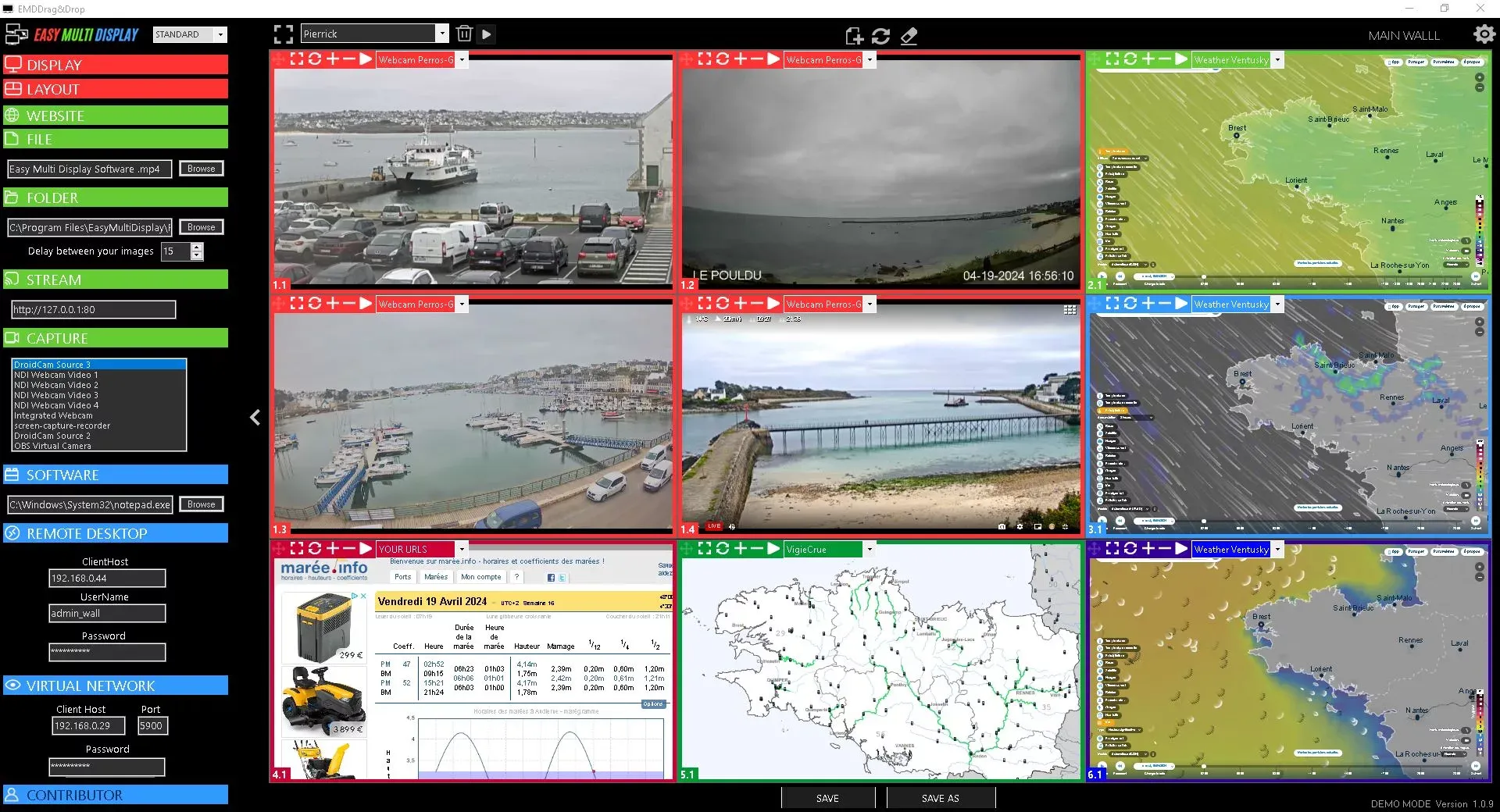
0WebsiteBuilt-in Chromium rendering engine. Several addresses can rotate within the same zone.
1FileImage, video or PDF stored locally.
2FolderAutomatic slideshow of the contents of a directory.
3Network streamRTSP, HTTP, HLS or DASH. IP cameras discovered automatically over ONVIF.
4CaptureHDMI input on a capture card. This is the mode used to mirror an operator workstation.
5SoftwareThe application is launched by the software and placed inside the zone. Office and business applications.
6Remote desktopRDP session to a machine on the network.
7Virtual networkVNC session. Nothing to install on the target machine, the software connects to the existing service.

A business application is not simply mirrored: the software launches it and places it in the intended zone. That is what makes it possible to display an application installed on the display server itself, without going through a capture.

Interoperability

What “compatible” actually means.

Command and control systems - NexSIS, SYSTEL, ARTEMIS - appear on the wall like any other source: HDMI mirroring of the operator workstation, network stream, or remote desktop. There is no software gateway to have developed, no access to request from their publisher, and no dependency on their release schedule.

We word it this way deliberately. “Compatible” does not mean here that the two pieces of software exchange data through a programming interface: it means that the display of the business system becomes a source of the wall, without asking anything of it. It is simpler, more robust, and it opens no access to their alerting system.

  • IP cameras discovered automatically over ONVIF, or entered as RTSP
  • Recognised brands: Axis, Hikvision, Dahua, Bosch, Vivotek, Hanwha, Uniview and others
  • The output of a video surveillance system displayed as a source
  • Mapping and geographic information systems through their web interface
  • Decision-support dashboards through their web interface
  • Drone feeds and video conferencing through an HDMI input

Network

The flows, and nothing else.

All the flows below stay inside the local network. None of them is meant to go out to the Internet. They must be restricted by firewall rule to the machines authorised to drive the wall: control of an operational video wall has no business being reachable from the whole network.

Network flow matrix
PortDirectionUse
5000 / TCPInbound, local networkControl of the main instance
30000, 30004, 30006, 30008…Inbound, local networkControl of each wall. One port per wall, configurable
6173 / TCPInbound, local networkMonitoring agent installed on every wall machine
8888 / TCPInbound, local networkWeb operator interface, when it is deployed
3389 / TCPOutbound, local networkRemote desktop to a displayed machine
5900 / TCPOutbound, local networkVNC session to a displayed machine
554, 8554 / TCPOutbound, local networkRTSP camera streams
3702 / UDPOutbound, local multicastAutomatic discovery of ONVIF cameras

What the software does not do. The software installed and licensed at the customer site opens no connection to a server of the publisher and transmits no operational data; it requires no online account. The only exception, the freely downloadable trial version measures its usage, to let us keep track of evaluations in progress: it is not intended for production. The wall carries on working when the Internet link of the site is cut. Some optional functions, on the other hand, do assume outside access and are clearly identified: playing video streams in HLS or DASH format, the remote relay of the Contributor module, and QuickShare field sharing. They are not required for the wall to work.

Licence

Perpetual, and checked offline.

The licence is a signed file, generated for one machine. At installation, the software displays a code derived from the hardware of the machine; that code is sent to us, we send back a signed licence file that is dropped into the software folder. The signature is checked locally, at every start-up.

  • RSA 2048-bit signature, SHA-256 fingerprint
  • No activation server, no Internet access required
  • No hardware dongle to keep
  • One-time payment, with no expiry date
  • Access to updates: 20 % of the licence price per year, free for the first year, never compulsory

NO SERVER
NO DONGLE
NO SUBSCRIPTION

a signed file, checked locally

Data

Where the data is, and who can read it.

Everything stays on the machine

Scenarios, zone configuration, source lists and settings are stored in the installation folder of the software. No operational data is hosted by the publisher, nor passed on to a third party.

No subprocessor

Since nothing leaves the infrastructure of the service, there is no subprocessor to declare under the General Data Protection Regulation for the display itself. The publisher is a French company, reached directly.

Protected credentials

The passwords of the software accounts and of the remote accesses are encrypted by the Windows data protection mechanism, tied to the machine. They are not stored in clear on the disk.

Reversibility

The hardware is standard and will stay standard: capture cards, graphics card and screens are off-the-shelf products. An equipped room can be taken over by another piece of software without changing a single cable.

Accounts and rights

One administrator account and up to three operator accounts, with separate rights across five areas of the interface. Enough to separate day-to-day operation from the configuration of the room.

Installation

A portable version runs from a folder, with no administrator rights and without altering any system file. It disappears when the folder is deleted. A digitally signed installable version is available as well.

Capacities and limits

The figures, ceilings included.

Software limits
ItemValueDetail
Zones per wall246 windows of 4 zones
Preset split modes10One zone, double, triple, quadruple, plus four variants with a main zone
Walls driven from a single workstationup to 10With the Multi-Wall module. The total number of zones that can actually be displayed depends on the machine and the sources
Screens drivenhardware limitNo software ceiling: the outputs of the graphics cards, extended when needed by video wall controllers. The real number comes down to the power of the machine
User accounts1 administrator + 3 operatorsSeparate rights across five areas of the interface
CollectivView islands20Physical sources aggregated on one wall

Two things not to confuse. The software composes up to 24 zones per wall and drives up to 10 walls from a single workstation. Multiplying the two gives a theoretical maximum of 240 zones that is not reached in practice: the power of the machine and the type of sources - some too heavy to be multiplied - reach their limit well before. The number of screens, for its part, has no software ceiling: it comes down to the outputs of the graphics cards, extended when needed by video wall controllers. Windows and Linux behave the same way, and the display stays independent of the number of mirrored workstations, which depends on the capture cards and the multiviewers.

Deployments

Six configurations, one common base.

These are the six variants we come across. All of them rest on the same chain: what changes is the number of servers, the split between inputs and outputs, and the nature of the control stations.

Emergency call centre

One server, eight inputs, an 86-inch panel plus a control screen and a touchscreen. The most widely deployed archetype.

Two twin rooms

One server per room, sized differently according to the number of workstations to mirror. The two rooms stay electrically and logically independent.

Departmental operations centre

Two rooms, multiviewers upstream, a main wall and a secondary wall, plus screens dedicated to decision-making, to crisis handling and to rest.

Mobile command vehicle

A centralised node of HDMI sockets inside the vehicle, four screens including one outdoor screen facing the field. The vehicle fitter wires it once and for all.

Temporary event setup

Several self-contained areas rigged then derigged: a full server on the main wall, Multiprise HDMI boxes on the secondary walls.

Industrial control room

No capture card at all: the sources are internal web pages. A master workstation drives display machines fitted with the EMD player over the local network.

The entry-level range

When a single screen is enough.

For a room that only needs to display eight workstations on a single screen, the architecture comes down to an 8-input, 1-output Multiprise HDMI, driven over a serial link from a mini PC and a 22-inch touchscreen. Thirteen display modes, no capture card, no network.

Its limit is known and owned. Beyond eight sources, a second Multiprise has to be cascaded, which brings a degradation of the resolution. A room that expects to go past eight workstations should start with a display server straight away.

See the Multiprise HDMI

8 INPUTS
1 SCREEN
0 NETWORK

RS232 serial link · 13 display modes

A specification to write?

Send us your room plan and the list of your workstations. We send back a dimensioned architecture drawing, the bill of materials and the costing, with no obligation.